
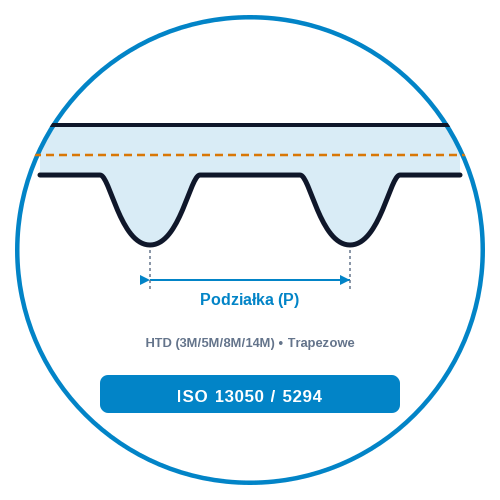
The main international standards specifying the dimensions and geometry of toothed pulleys are ISO 5294 and ISO 13050.
Most HTD belts and pulleys were developed as a patented solution by Gates, but their dimensions have since been preliminarily standardised or described in international standards and industrial catalogues (DIN/ISO).
Key Standards for Toothed Pulleys
- ISO 13050 — The key standard for pulleys and belts with a curvilinear (rounded) tooth profile (e.g. HTD 3M, 5M, 8M, 14M), STD / STS, and RPP.
- ISO 5294 — The standard specifying dimensions, tolerances, and pulley pitches for toothed belts with a trapezoidal tooth profile (classic imperial profiles: MXL, XL, L, H, XH, XXH).
- ISO 17396 — The standard covering toothed pulleys for metric belts with T and AT profiles (T2.5, T5, T10, AT5, AT10), commonly used in automation and optics (corresponds to the German standard DIN 7721).
HTD Profile (ISO 13050) – Dimensions and Pitches
HTD profiles feature a rounded (involute-curvilinear) tooth.
This prevents stress concentrations at the corners and allows significantly higher torque transmission than older trapezoidal profiles.
Main pitch sizes ($P$) in the HTD system:
| HTD Profile | Pitch P [mm] | Typical application |
| HTD 3M | 3,0 mm | Precision tools, 3D printers, light automation. |
| HTD 5M | 5,0 mm | Small electric motors, power tools, automation. |
| HTD 8M | 8,0 mm | Industrial standard, CNC machine tools, conveyors. |
| HTD 14M | 14,0 mm | Heavy industry, high-torque drives. |
| HTD 20M | 20,0 mm | Very heavy-duty industrial and steel-mill drives. |
Geometry and Designations of Toothed Pulleys
When ordering or designing HTD pulleys in accordance with the standard, a standard designation system is usually used,