
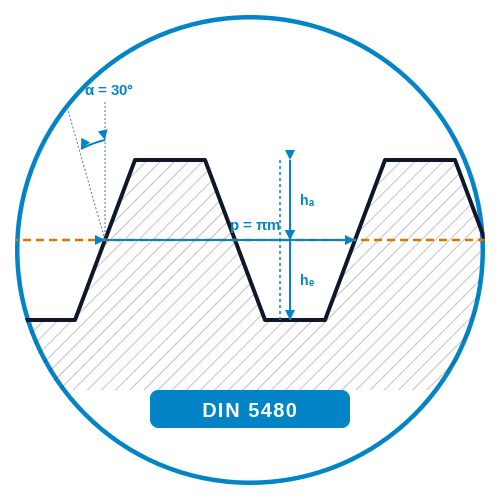
The DIN 5480 standard is one of the most important German and international technical standards, defining requirements for involute splines.
It is used to design and manufacture shaft-hub connections that must transmit high torque while maintaining precise component centering.
Key features of connections in accordance with DIN 5480
- Involute tooth profile: As in typical gears, the tooth flanks follow an involute curve. This ensures smooth engagement, reduces stress concentrations at the tooth root, and simplifies manufacturing (using the same methods as for gears).
- Pressure angle (\alpha): The standard value is 30^\circ. This distinguishes the standard from the older DIN 5482 (which used various angles) and from American standards (e.g. ANSI B92), which often use 37,5^\circ or 45^\circ.
- Flank centering:
In the vast majority of cases, the shaft and hub are positioned relative to each other by contact between the tooth flanks. This ensures an even distribution of forces. Centering on the major or minor diameter is used less frequently.
- Reference diameters:
The spline dimensions are based on the so-called reference diameter (d_B), making it easier to select standard rolling bearings that can be mounted on the shaft next to the spline.
- Use of profile shift:
The standard commonly uses profile shift (x \cdot m) to achieve the required tip and root diameters and optimise tooth strength.