
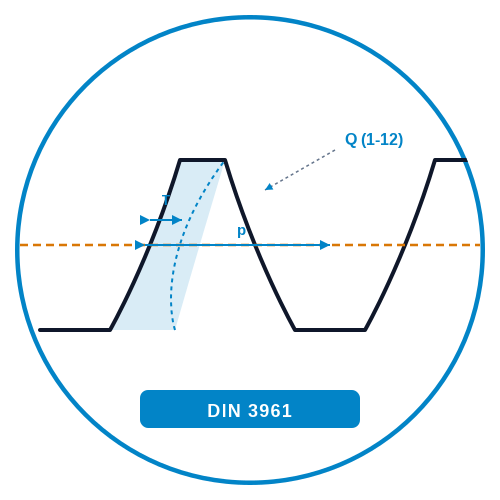
The DIN 3961 standard (“Tolerances for cylindrical gears; Fundamentals”) is a fundamental German technical standard that defined accuracy systems for spur and helical cylindrical gears for decades. Although it is now considered inactive (having been superseded by the international standards in the ISO 1328 series), its influence on the mechanical engineering industry, particularly in Europe, remains significant, and many older designs and machines still rely on it.
Here is a detailed explanation of its role, structure, and application.
1. Main purpose of DIN 3961
The main purpose of DIN 3961 was to establish a uniform system for classifying gear accuracy. The standard does not specify numerical tolerance values (these are specified in related standards, such as DIN 3962), but it defines:
- Accuracy grades.
- Basic terms and definitions relating to geometric errors and deviations.
- Rules for calculating tolerances according to gear parameters (module, diameter, face width).
The purpose of this system is to ensure that gears manufactured by different manufacturers to the same accuracy grade will mesh correctly with one another.
2. Accuracy grades
DIN 3961 defines 12 accuracy grades, numbered from 1 to 12.
- Principle: The lower the grade number, the higher the manufacturing precision and the tighter the tolerances.
- Increase in tolerance: Tolerances increase geometrically from one grade to the next. Each grade has tolerances approximately $\sqrt{2}$ (1.41) times greater than the preceding grade.
3. Relationship to other standards (system structure)
DIN 3961 is the “core” of the system, but it works in close conjunction with other DIN standards that together formed a complete tolerancing system:
| DIN standard | Title / Role in the system |
| DIN 3961 | Fundamentals. Defines grades, terms, and principles. |
| DIN 3962 (Parts 1–3) | Tolerance tables. Specifies numerical deviation values for each grade and dimension. |
| DIN 3963 | Runout tolerances. |
| DIN 3964 | Center distance deviations. |
| DIN 3967 | Backlash and tooth thickness tolerances. |
| DIN 3960 | Geometric terms for gears. |
4. DIN 3961 and ISO 1328 (current standard)
As part of standards harmonization, the DIN system was superseded by the international ISO 1328 system. Although both systems are based on similar mathematical principles and an involute tooth profile, they are not identical:
- Numerical values: Tolerances for the same grade (e.g. DIN 6 vs ISO 6) may differ slightly.
Summary
The DIN 3961 standard is a landmark standard that organized gear manufacturing by introducing a clear system of 12 accuracy grades. If you encounter a designation such as “DIN 3962 gear, grade 7” in older technical documentation, it means that the entire approach to its accuracy, load-carrying capacity, and smooth operation is based on the fundamentals defined in DIN 3961. For new designs, however, the ISO 1328 standards are recommended.