
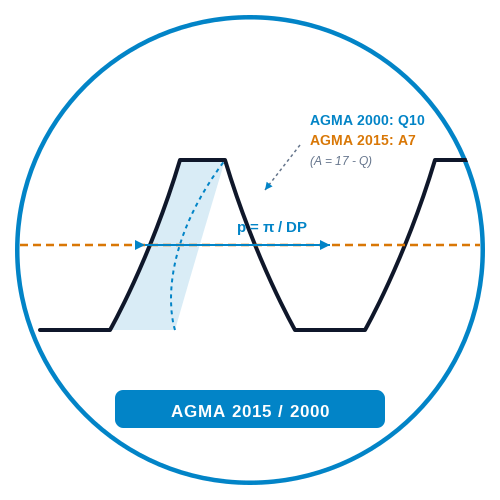
AGMA 2000 and AGMA 2015 represent two different eras of American Gear Manufacturers Association standards used to classify the accuracy of cylindrical gears (both spur and helical).
The key point is this: AGMA 2000-A88 has been withdrawn (is obsolete), while ANSI/AGMA 2015-1-A01 is the modern standard, developed to harmonize U.S. practices with international ISO standards.
Here is a detailed description of both standards and a comparison.
1. AGMA 2000-A88 (Withdrawn/Obsolete)
Published in 1988, it was the default gear quality specification system in the United States for several decades. Although officially withdrawn by AGMA, it is still commonly found in older technical documentation and contracts.
2. ANSI/AGMA 2015-1-A01 (Modern Standard)
First published in 2002, this standard represents a fundamental change. It was developed to harmonize U.S. gear accuracy standards with international standards (specifically, ISO 1328-1).
Comparison Table
| Feature | AGMA 2000-A88 | ANSI/AGMA 2015-1-A01 |
| Status | Withdrawn (Obsolete) | Active (Current Standard) |
| Global compatibility | Unique U.S. standard | Compatible with ISO 1328 |
| System | Imperial/Metric equivalents | Metric (Defined by formulas) |
| Designation | “Q” followed by a number (e.g., Q10) | “A” followed by a number (e.g., A7) |
| Numbering logic | Higher number = Better quality | Lower number = Better quality |
| Direction of scale | Reverse scale | Standard/ISO scale |
| Focus on errors | Total error within the tolerance band (K charts) | Separate slope, form, and total errors |
Approximate correlation:
Gears manufactured to AGMA 2000 cannot be correlated exactly with AGMA 2015 because the mathematical formulas and error definitions have changed. However, for preliminary design assessments, engineers often use the “Rule of 17” as an approximate guide.
Note: This is only an approximation. Tolerance values should be calculated in accordance with the applicable standards for actual qualification.